This post contains affiliate links. As an Amazon Associate, we may earn a commission from qualifying purchases at no extra cost to you.
If you’re building a home gym on a budget, you probably don’t want to buy both dumbbells and kettlebells right away. So which one do you start with? It’s one of the most common questions in home fitness — and the answer depends entirely on what you’re actually trying to accomplish.
Here’s an honest breakdown of both, where each one wins, and how to make the right call for your situation.
What’s the Actual Difference?
At first glance, dumbbells and kettlebells look like they do the same thing — they’re both handheld weights you lift. But the way the weight is distributed changes everything about how you use them.
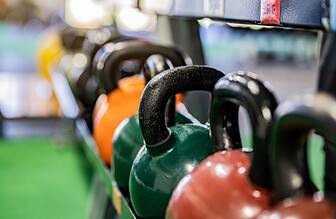
A dumbbell has the weight centered in your hand. A kettlebell has the weight hanging below your hand. That offset changes your center of gravity, which changes which muscles work, how hard they work, and what movements are even possible.
That one design difference is why dumbbells and kettlebells each excel at completely different things.
Where Dumbbells Win
Isolation exercises. Bicep curls, tricep extensions, lateral raises, chest flyes — movements where you’re targeting one specific muscle. The balanced weight of a dumbbell makes these movements clean and controllable.
Upper body pressing. Dumbbell bench press and overhead press allow a greater range of motion than a barbell and are easier to load progressively than kettlebells.
Beginners learning basic movements. Dumbbells are more intuitive. Pick them up and start pressing or curling — there’s no technique learning curve the way there is with kettlebell swings or cleans.
Exercise variety. With one pair of dumbbells you can perform dozens of exercises across every muscle group. The variety ceiling is higher than kettlebells.
Precise progressive overload. Adjustable dumbbells let you increase weight in small, controlled increments — critical for consistent strength gains over time.
Best for: Building muscle, upper body strength, beginners, isolation work, structured programs.
Where Kettlebells Win
Ballistic movements. The swing, snatch, and clean are explosive hip-hinge movements that build power, conditioning, and posterior chain strength simultaneously. You simply can’t replicate these with a dumbbell.
Cardio and strength in one. A 20-minute kettlebell circuit delivers strength and cardiovascular benefits that would otherwise require two separate workouts. Time-efficient training at its best.
Grip and forearm strength. The thicker handle and offset weight make kettlebell training significantly harder on your grip — which builds forearm and hand strength as a byproduct of every session.
Core activation. Because the weight is offset and often moving dynamically, your core works harder to stabilize throughout kettlebell movements than in most dumbbell exercises.
Functional movement patterns. Hip hinges, rotational power, single-leg work — kettlebells train movement patterns that translate directly to athletic performance and daily life.
Best for: Fat loss, conditioning, functional strength, time-efficient workouts, posterior chain development.
Head-to-Head Comparison
| Category | Dumbbells | Kettlebells |
|---|---|---|
| Exercise variety | ✓ Higher | Lower |
| Cardio benefit | Lower | ✓ Higher |
| Beginner-friendly | ✓ Easier | Steeper curve |
| Muscle isolation | ✓ Better | Not ideal |
| Full-body conditioning | Limited | ✓ Excellent |
| Cost for full range | Higher | ✓ Lower |
| Space required | More | ✓ Less |
| Grip development | Moderate | ✓ Superior |
| Progressive overload | ✓ Easier | Harder |
| Portability | Moderate | ✓ Better |
So Which Should You Buy First?
Buy dumbbells first if:
- You’re a complete beginner to resistance training
- Your primary goal is building muscle or losing fat through structured lifting
- You want to follow a traditional workout program (most are written for dumbbells)
- You have kids or others in the home who might also use the equipment
- You prefer a wide variety of exercises over a smaller set of highly effective ones
Buy a kettlebell first if:
- You’re already reasonably active and want to add strength training
- Your primary goal is fat loss and conditioning rather than muscle building
- You’re short on time and want maximum results from 20–30 minute sessions
- You have very limited space
- You’re interested in functional fitness, athletic performance, or martial arts
The honest answer for most people: Start with dumbbells. They’re more versatile, more beginner-friendly, and easier to build a complete program around. Add a kettlebell once you’ve built a strength base and want to incorporate more conditioning work — the two tools complement each other perfectly at that point.
The Best of Both Worlds
If budget allows, a simple combination works extremely well for a home gym:
- One pair of medium dumbbells (or adjustable set) for upper body and isolation work
- One kettlebell at an appropriate starting weight for swings, goblet squats, and conditioning circuits
That combination — two pieces of equipment — covers the vast majority of what most home gym users actually need.
For our top dumbbell picks, see our Best Dumbbells for Home Gyms in 2026 guide. For kettlebell recommendations, see our Best Kettlebells for Beginners guide.
Frequently Asked Questions
Can I build the same muscle with kettlebells as with dumbbells?
You can build significant muscle with kettlebells, but dumbbells give you more control over progressive overload and isolation — both of which are key drivers of muscle growth. For pure muscle building, dumbbells have the edge.
Are kettlebells more dangerous than dumbbells?
Not inherently, but they have a steeper technique learning curve. A poorly executed kettlebell swing puts stress on your lower back in a way a dumbbell curl does not. Learn the movement pattern correctly before loading up.
Can I do kettlebell swings with a dumbbell?
You can do a dumbbell swing, but it’s not the same movement. The shape of the kettlebell — specifically the handle above the bell — is what makes the swing mechanics work correctly.
Is one better for weight loss?
Kettlebells have a slight edge for calorie burn due to the cardio component of ballistic movements. However, the best tool for weight loss is the one you’ll actually use consistently.
Do I need both eventually?
Most serious home gym users end up with both — they genuinely complement each other. But neither is required to have an effective home workout program on its own.