This post contains affiliate links. As an Amazon Associate, we may earn a commission from qualifying purchases at no extra cost to you.
Massage guns have gone from professional recovery tools used by elite athletes to mainstream fitness accessories found in home gyms everywhere. And for good reason — the right massage gun can dramatically reduce muscle soreness, improve circulation, and speed up recovery between workouts in 5–10 minutes of targeted use.
But the market is flooded with options ranging from $30 to $600, and the differences between them matter more than the price tag suggests. Here’s exactly what to look for and our top picks for 2026.
What Does a Massage Gun Actually Do?
A massage gun delivers rapid percussive therapy — short, powerful pulses of pressure deep into muscle tissue. This differs from foam rolling (which applies sustained surface pressure) by penetrating deeper into the muscle belly and stimulating blood flow more aggressively.
The research on percussive therapy consistently shows benefits including reduced delayed onset muscle soreness (DOMS), improved range of motion, faster muscle recovery between sessions, and reduced perception of muscle tightness and fatigue. Used correctly, it’s one of the most time-efficient recovery tools available.
Key Features to Understand
Percussion speed (RPMs/PPM) — How many times the head strikes per minute. Most massage guns range from 1,200–3,200 percussions per minute. Higher speeds aren’t always better — different speeds work best for different tissues. Lower speeds (1,200–1,800 PPM) for sensitive areas, higher speeds (2,400–3,200 PPM) for large, dense muscle groups like quads and glutes.
Amplitude — How deep the head travels into the muscle with each strike. This is arguably the most important spec. Cheap massage guns have 6–10mm amplitude — they vibrate more than they percuss. Quality guns have 12–16mm amplitude — deep enough to actually affect muscle tissue. Always check amplitude before buying.
Stall force — How much pressure the gun can handle before the motor stalls. Budget guns stall at 20–30 lbs of pressure — not enough for dense muscle groups. Quality guns handle 40–60+ lbs, letting you actually lean into the device during use.
Noise level — Measured in decibels. Budget guns often run 70–80 dB (loud). Quality guns run 40–60 dB (quiet conversation level). If you use it while watching TV, in an office, or when others are asleep, noise matters significantly.
Battery life — Most quality massage guns deliver 2–4 hours of continuous use per charge. Cheap guns often deliver 1 hour or less. Check reviews for real-world battery performance rather than marketing claims.
Attachments — Standard sets include a ball (large muscle groups), flat head (general use), bullet (trigger points), and fork (spine and Achilles). More attachments isn’t always better — you’ll primarily use 2–3 regardless of how many come in the box.
Weight — Heavier guns (2.5 lbs+) cause arm fatigue during longer sessions. Lighter guns (1.5–2 lbs) are more practical for self-use on hard-to-reach areas like upper back and shoulders.
Types of Massage Guns
Full-Size Massage Guns
Standard size with a long handle for reaching your back and legs. Most powerful option with the highest amplitude and stall force. Best for serious recovery work and larger muscle groups.
Mini/Compact Massage Guns
Smaller and lighter — fits in a gym bag or suitcase. Lower amplitude and stall force than full-size options but significantly more portable. Great for targeted use on smaller muscle groups and travel.
Quiet/Whisper Guns
Specifically engineered for low noise output. Slightly less powerful than equivalent-priced standard guns but run at a library-quiet level. Worth the trade-off for apartment dwellers or office use.
Budget Percussion Massagers
Under $50 options that deliver basic percussive therapy. Lower amplitude, lighter stall force, and shorter battery life than premium options — but perfectly adequate for casual users doing 2–3 workouts per week.
How to Use a Massage Gun Correctly
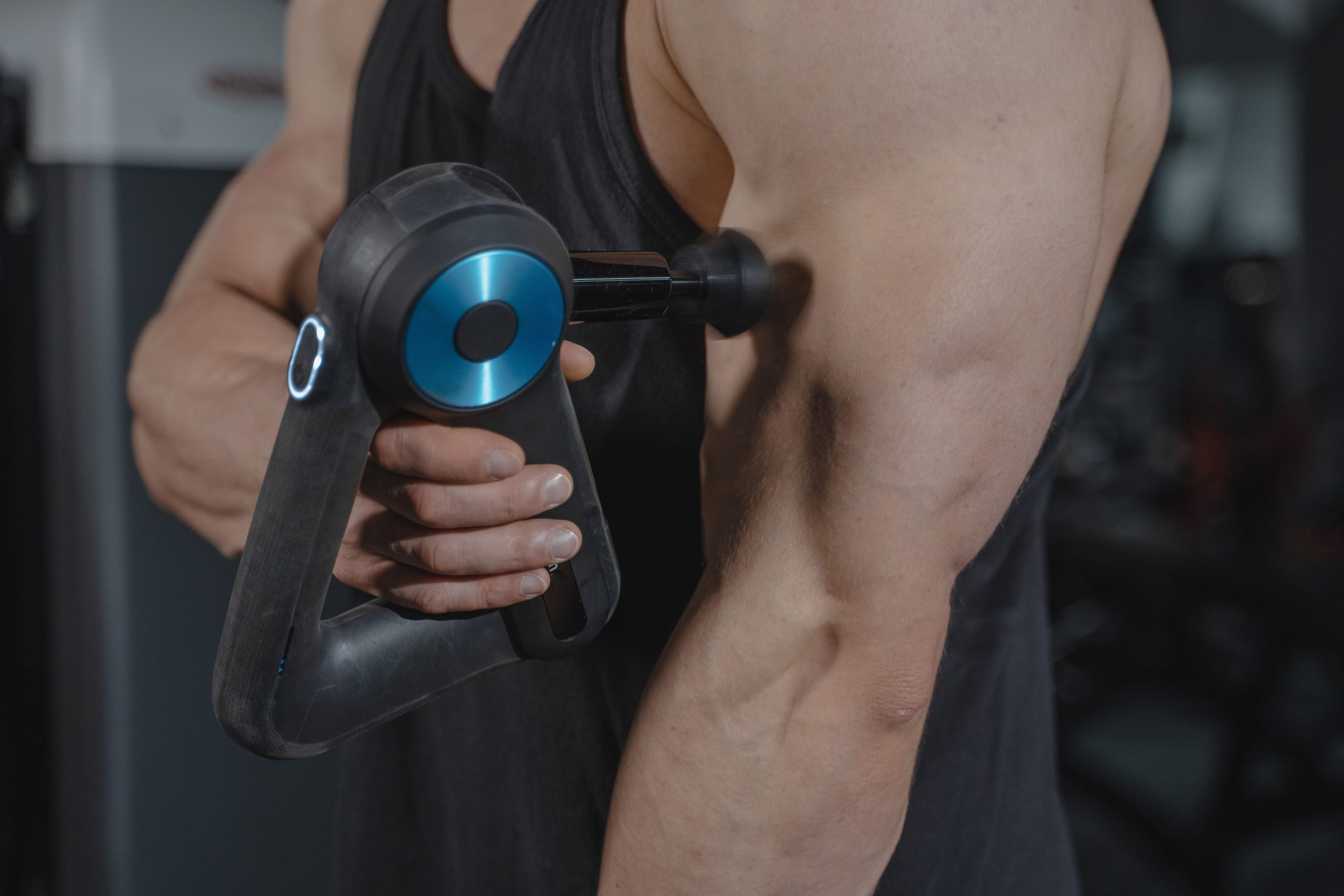
Float the gun — don’t press hard. Let the percussion do the work. Pressing hard into the gun reduces the amplitude and can bruise superficial tissue. Light contact with the skin, letting the head float over the muscle.
Move slowly. Glide the gun at roughly 1 inch per second over the muscle belly. Don’t linger in one spot for more than 15–20 seconds.
Avoid bones, joints, and nerves. Use only on muscle bellies — not directly on the spine, knee joint, elbow, or any bony prominence. The IT band is also a common mistake — it’s a tendon, not a muscle, and direct percussion aggravates it.
Start on the lowest setting. Always begin on the lowest speed, especially on a new area. Work up to higher speeds once the muscle has warmed up to the pressure.
Use for 1–2 minutes per muscle group. More isn’t better. 60–90 seconds per muscle group before or after a workout is the evidence-based sweet spot. Longer sessions don’t add meaningful benefit and can cause bruising.
Our Top Picks for 2026
| Massage Gun | Amplitude | Noise Level | Best For | Link |
|---|---|---|---|---|
| Theragun Relief Deep Tissue Massager | 16mm | Moderate | Best overall | View on Amazon |
| TOLOCO Percussion Massager | 12mm | Moderate | Best budget | View on Amazon |
| arboleaf Quiet Percussion Massager | 14mm | Very low | Best quiet | View on Amazon |
| NEPQ Mini Portable Massage Gun | 10mm | Low | Best travel/mini | View on Amazon |
Frequently Asked Questions
How often should I use a massage gun?
Daily use is safe for most people when applied correctly. Pre-workout for 60–90 seconds per muscle group to increase blood flow and warm up tissue. Post-workout for the same duration to reduce soreness and speed recovery.
Can a massage gun replace a professional massage?
For maintenance recovery and general soreness, yes — it delivers similar benefits in a fraction of the time and cost. For specific injury treatment, structural issues, or lymphatic work, a licensed massage therapist provides benefits a massage gun cannot replicate.
Is a massage gun safe for everyone?
Avoid use over open wounds, bruises, varicose veins, or areas of inflammation or acute injury. People with blood clotting disorders, osteoporosis, or nerve damage should consult a physician before use.
What’s the difference between a cheap and expensive massage gun?
The main differences are amplitude (how deep the head travels), stall force (how much pressure it handles), noise level, and battery life. A $50 gun vibrates; a $200 gun percusses. The difference in feel and effectiveness is significant.
Where should I not use a massage gun?
Avoid the spine, neck, head, joints, bony areas, IT band, and any area with acute pain or injury. Always work on muscle bellies only.